
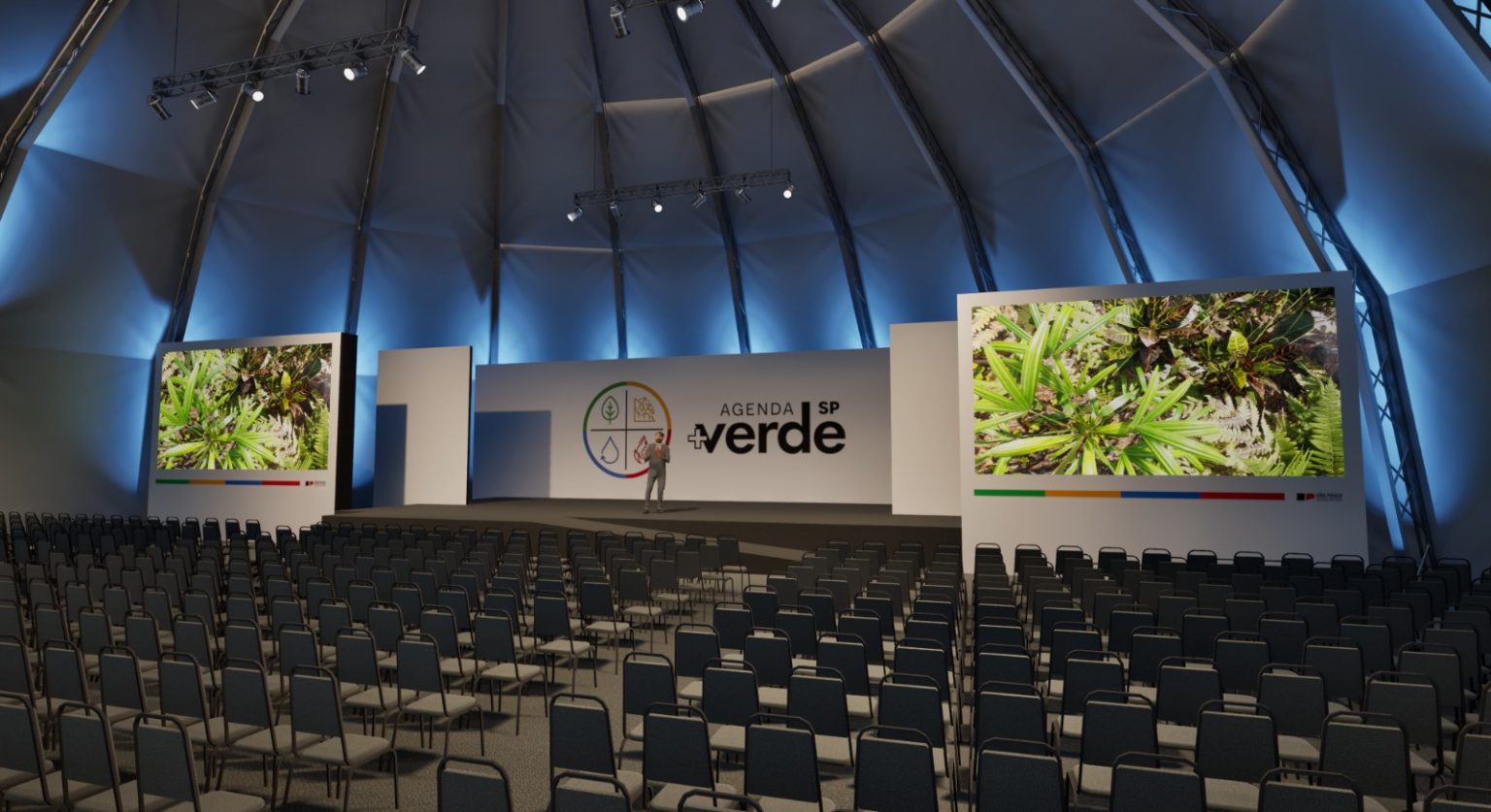
With 100 debates spread across seven stages, the event will connect dozens of CEOs, national and international executives, political and institutional leaders, and researchers, as well as prominent figures in the social field.
The Agenda SP + Verde Summit will transform São Paulo, on November 4th and 5th, into the epicenter of a major debate on sustainable development. The event will take place at Villa-Lobos Park, where a massive structure is being prepared to accommodate approximately 500 speakers and 10,000 attendees over the two days.
On the main stage, with a capacity of 1,000, the event will open with a strategic debate on the “New Vision of the Green Economy.” The panel will feature São Paulo Governor Tarcísio de Freitas and will be moderated by Joaquim Leite, former Minister of the Environment. This stage, called “Green Economy,” and exclusively sponsored by the Cosan group, will also feature CEOs of major companies in discussions on decarbonization, sustainable infrastructure, and artificial intelligence. He will also host municipal authorities, including Mayors Ricardo Nunes (São Paulo), Dário Saadi (Campinas), Rogério Santos (Santos), and Rafael Piovezan (Santa Bárbara d’Oeste), who will discuss the role of municipalities in a panel on the 5th.
Several international figures from major companies and organizations have confirmed their attendance. Jennie Cato, Global Head of Public Affairs and Governmental Relations at TRATON Group – Scania, and Luz Stella, president of the Colombian Natural Gas Association, will discuss effective solutions for decarbonizing the Brazilian transportation matrix. Katerina Elias-Trostmann, LATAM Director at Salesforce, will address water security, climate, and development. Wolfgang Dieker, Global Head of Government Affairs and CSR at SAP, will discuss corporate technologies for climate change mitigation in a panel, while Alberto Mina, Director of Institutional Relations at MIND in Milan, will share his experiences in technological innovation and urban regeneration.
The panel of CEOs and corporate leaders brings together leading figures from the climate and infrastructure agenda. São Paulo’s Secretary of Environment, Infrastructure, and Logistics, Natália Resende, participates in the panel on infrastructure as a driver of socio-environmental transformation, alongside Brendon Ramos, CEO of Via Appia/Rodoanel, and Carlos Piani, CEO of Sabesp. The discussion on low-carbon transportation is then moderated by José Eduardo Moreira, CEO of Necta. The ecological restoration agenda features the largest collaborative case study of Atlantic Forest reforestation, presented by Olavo Correa, president of AstraZeneca Brazil. At the interface between climate and health, Sidney Klajner, president of Hospital Israelita Albert Einstein, addresses the integrated response based on the One Health concept. The potential of rail transportation in the sustainable transition is detailed by André Salcedo, executive vice president of Business at Motiva Trilhos. The group advances the energy sector decarbonization agenda with contributions from João Brito Martins, CEO of EDP South America, Gustavo Estrella, CEO of CPFL, and Miguel Setas, CEO of Motiva. Next, Gilberto Peralta, CEO of Airbus Brazil and director of the FIESP Defense Department, addresses the challenges and opportunities for sustainable aviation in São Paulo. On the economic and institutional front, Gustavo Montezano, CEO of YvY Capital, discusses the role of climate finance in public policy. The implementation of industrial circularity is presented by Alvaro Lorenz, Global Director of Sustainability, Institutional Relations, Product Development, and Engineering at Votorantim Cimentos.
Participating Organizations
The group of strategic institutions will bring together prominent representatives to discuss key issues of sustainability and the energy transition, beginning with the role of public policy and climate finance in sustainable transformation, with Joaquim Levy, president of the FIESP Sustainable Development Council. The agenda also addresses sustainable aviation, discussing challenges and opportunities for São Paulo, with Evandro Gussi, CEO of Única (Sugarcane and Bioenergy Industry Union), and Juliano Noman, president of ABEAR (Brazilian Airlines Association). Finally, the decarbonization trajectory of industrial sectors will be presented by Paulo Camillo Penna, president of the Brazilian Portland Cement Association and the National Cement Industry Union; Lucien Belmonte, executive president of the Brazilian Glass Association (ABIVIDRO); and Ambassador José Carlos da Fonseca, institutional director of the Brazilian Tree Industry (IBÁ), providing a comprehensive overview of the paths towards sustainable transition in the industry.Detectar idiomaPortuguês (Brasil)InglêsEspanhol
Distinguished Academics
Renowned researchers such as Alexander Turra, professor at the Oceanographic Institute of USP and head of the UNESCO Chair for Ocean Sustainability; Suely Mara Vaz Guimarães de Araújo, researcher at USP and former president of Ibama; Paulo Nobre and others will reinforce the integration between science, public policy, and corporate practices, contributing to discussions on oceans, urban sustainability, climate change, and innovation.
Personalities
Among the remarkable life stories present at the Summit, Laura Braga stands out, chef of the Quilombo da Fazenda restaurant in Ubatuba, and an important quilombola leader who works to defend memory, territory, and traditional ways of life. In addition to participating in the panel “Traditional Knowledge for Land and Life,” she will also lead the sustainable cooking workshop “Caponata do Coração da Banana” on November 4th, from 4:00 pm to 5:00 pm, at the Sustainable Gastronomy Space. Registration is on a first-come, first-served basis.
In the panel “Female Protagonism in the Face of Climate Change,” one of the featured voices is Aretha Duarte, a mountaineer and the first Black Brazilian woman to reach the summit of Mount Everest. Born in the outskirts of Campinas, São Paulo, Aretha became a symbol of determination by financing part of the expedition by collecting 130 tons of recyclable material, connecting her athletic achievement to the sustainability agenda. Her journey will be revisited at the meeting, based on the experience that transformed her into a national reference for inspiration, environmental education, and concrete action in the face of the climate crisis.
The panel “Innovating to Feed: Smart Cities and Nutritional Security” will feature Cíntia Sanchez, a chef, social project manager, and food activist for over 24 years. Francisco’s mother and a contestant on MasterChef Profissionais (2023), Cíntia has dedicated her career to defending the democratic right to quality food and addressing food inequalities in Brazil. She currently coordinates the “It’s All for Yesterday” Institute and works as a chef at Manje Culinária, where she also leads consulting and catering services.
Among the voices addressing circularity in culture is designer Heloisa Faria, a leading figure in original and sustainable fashion in Brazil. Leading her brand since 2010—which has already been presented at events such as SPFW and Casa de Criadores—Heloisa develops pieces using upcycling and national fabrics, focusing on longevity, inclusion, and a break with disposable trends. She participates in the panel “Creative Circularity: Sustainability in Cultural Industries,” which discusses how design, production, and reverse production processes can reduce environmental impacts in the creative sector.
The panel “Blue Breath: The Role of the Seas in the Balance of Climate and Life” features David Schurmann, filmmaker, screenwriter, producer, and CEO of the NGO Voz dos Oceanos, an initiative of the Schurmann Family focused on combating plastic pollution in the oceans. Having grown up aboard sailboats on expeditions around the world, David combines his experience as an explorer with an audiovisual career dedicated to telling stories that connect science, education, and innovation for marine conservation, inspiring global solutions for ocean preservation.
Among the event’s participants is Hermes de Sousa, CEO of the Cacimba Institute, a community organization located in the União de Vila Nova favela in São Miguel Paulista. A social entrepreneur, Hermes founded the institute to develop productive inclusion, education, culture, and environmental projects in the region, supporting local organizations, collectives, and movements. He participates in the panel “Active Communities: Territories of Hope,” discussing strategies for social engagement and territorial development.
About the event
The Agenda SP+Verde Summit is a pre-COP event organized by the Government of São Paulo, the City of São Paulo, and the University of São Paulo. Discussions are organized around four thematic areas: Green Finance; Resilience and the Future of Cities; Climate Justice and Sociobiodiversity; and Energy Transition and Decarbonization. A circular economy track will span all stages and extend to the Circularity Hub, offering experiences, workshops, and experiences curated by the Circular Movement. In the area of innovation, universities, institutes, and technology districts will discuss the role of research and technology in São Paulo’s climate transformation. On the main stage, the green economy will be the center of discussion, with the presence of political leaders and special guests. An international business roundtable will bring together approximately 70 companies from eight countries.
Beyond the debates, the Summit Agenda SP + Verde offers practical and cultural experiences: 20 workshops on sustainable gastronomy and circularity, artistic presentations by the OSESP choir and Baccarelli, an indigenous choir, shows by Zizi Possi, Grupo Street Dance and Baile do Simonal. Guided tours of green economy and sustainable tourism case studies are also available. The diverse and inclusive program promotes connection, integration and engagement, consolidating São Paulo as an international reference in green economy and sustainability.
The Summit Agenda SP+Verde is the result of a broad mobilization for sustainable development, sponsored by Cosan, Comgas, Edge, Rumo, Sabesp, Itaú, Amazon, Votorantim Cimentos, EcoUrbis, Solvi, Loga, Motiva, EDP, CPFL, Bracell, Veolia, Metrô, Stellantis, Ecovias, Toyota, JHSF and Tetra Pak; and institutional support from Fiesp, Senai, Única, Aesabesp, Abrainc, Secovi-SP, Associação Comercial de São Paulo, Pateo 76, Abiogás, SP Águas, Cetesb, DER-SP, Fundação Florestal, Arsesp, Prefeitura de Campinas, B3, The Nature Conservancy, Cebds, Pacto Global, SOS Mata Atlântica, Movimento Circular, União BR, Circular Brain, CET-SP, Dia da Terra, Instituto de Conservação Costeira, Inovaclima, IPT, Zeros, Ideia Sustentável, Kearney, Instituto Baccarelli, Zero Summit, Parque Villa-Lobos, NEOOH, Global Renewables Alliance (GRA) and Research Centre for Greenhouse Gas Innovation (RCGI).
Service: Summit Agenda SP+Verde
Date: November 4th and 5th, 2025
Time: 9 AM to 9 PM
Where: Villa-Lobos Park (main entrance), São Paulo — SP
Free admission
Full program, ticket collection and registration for guided tours at: www.agendaspmaisverde.org